The traditional Armenian card game
Pastura
Բարի՜ եկաք — welcome to the table
A table, four cards in your hand and an opponent to outplay. Practice against the computer, play online one on one or two on two, and climb the rating.
On Android? The Android version is in closed testing on Google Play for now. Send us a Direct message on Instagram and we will send you an invite.
- Free
- No ads, no in-app purchases
- iPhone and iPad
- English and Russian
Rules in a minute
How Pastura is played
A 52-card deck: four cards to each player and four on the table. On your turn you play exactly one card — and decide whether to leave it on the table or take what it matches.
Capture
A card takes table cards of the same rank, or several cards that add up to its rank. Play a seven and take a seven, 3 + 4 or 2 + 2 + 3.
The Jack
The Jack sweeps the whole table except queens, kings and builds. A queen takes only a queen, a king only a king.
Builds
Combine a card from your hand with table cards, declare a new value and take it on your next turn. Your opponent can steal the build if they hold the right card.
Pastura
A capture that leaves the table empty is a pastura, worth an extra point. A Jack scores one only when it takes a lone Jack.
Ա, Բ, Գ, Դ are Armenian letters that for centuries also served as numbers: one, two, three, four.
Points per deal
A match runs to 81 points one on one and to 101 with four players. A 16:0 deal is a capot and ends the match on the spot. The full rules are in the game, under Rules.
- Each jack1
- Each ace1
- Two of clubs2
- Ten of diamonds3
- Most cards3
- Each pastura1
Three ways to take a seat
Modes
Practice
Against the computer, two or four players — even offline. The opponent adapts to you: win and the next match is a little harder, lose and it is a little easier.
Online
One on one and two on two against live players: quick match or your own room by code. Classic to 81 points, short to 51, and blitz over two deals.
Rated match
A match against the computer, run by the server. The result cannot be forged, which is why only this mode counts toward the rating.
And also
- Daily challenges and a streak reward
- Three leaderboards: rated, online and challenges
- Achievements, match history and profile stats
- Friends and table invites by link
- Rematch in the same room and a head-to-head record
- Chat and sixteen emotes, teasing ones included; profanity is masked automatically
- Three decks: Classic, Atlas and Russian, after the 1911 deck
- Light and dark theme, English and Russian
From the app
What it looks like
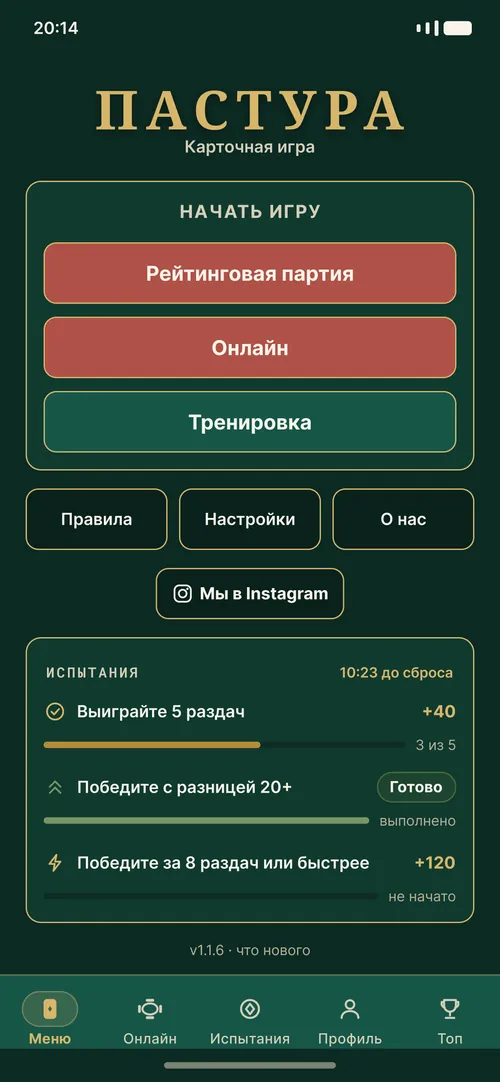
Main menu 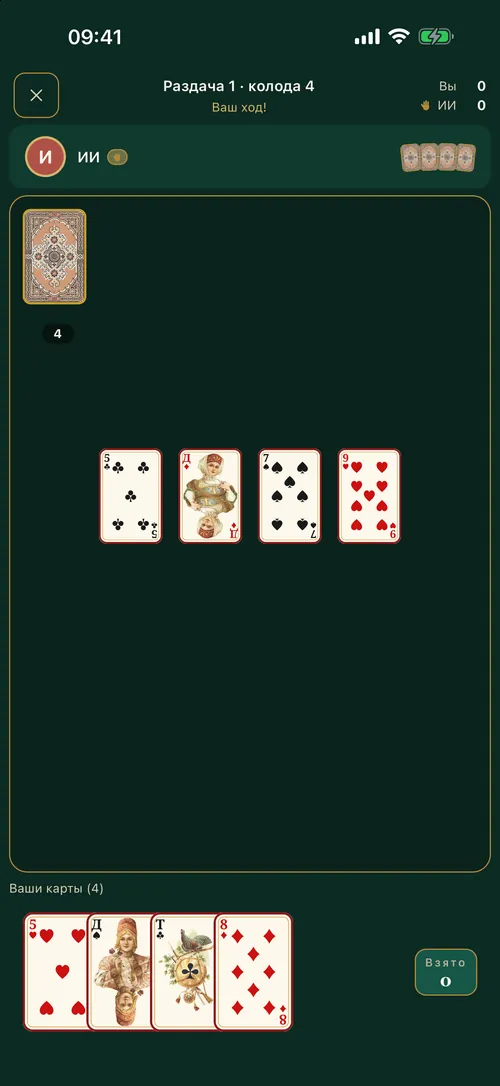
A match against the computer 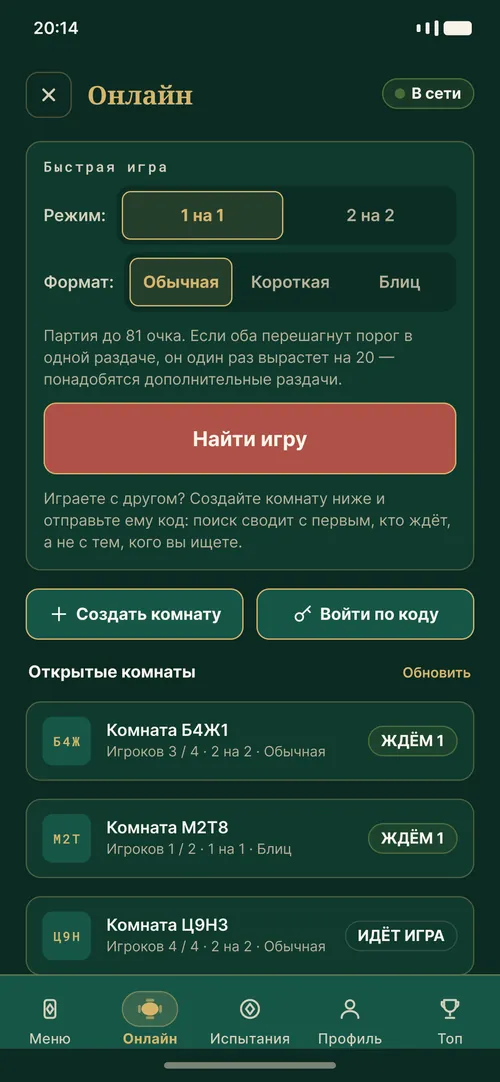
Online: quick match and rooms 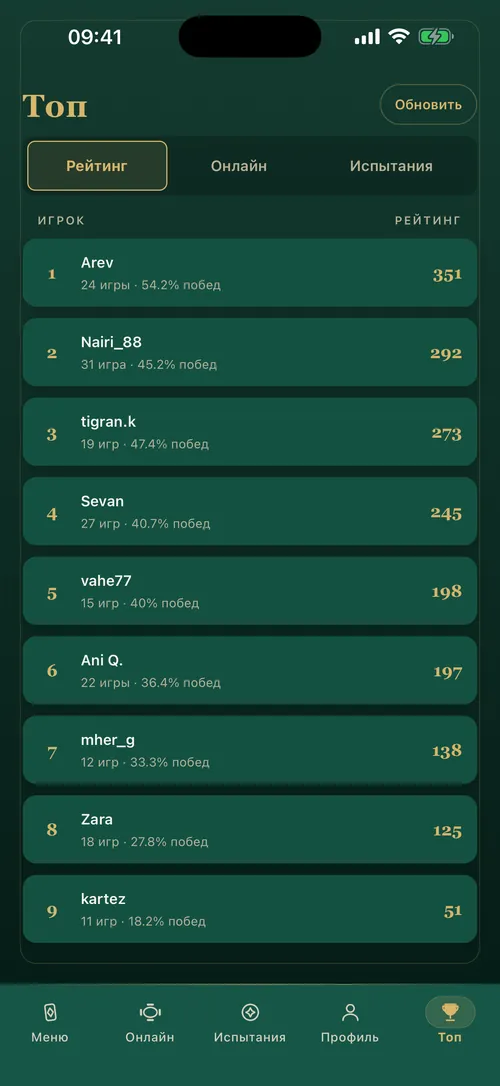
Leaderboard
Screens from the Russian version; the app speaks English too.
Achievements
Fourteen badges in three tiers — bronze, silver and gold. Online and rated matches unlock them; practice does not count.
 First BloodWin your first gamebronze
 Card CollectorPlay 10 gamesbronze
 Lucky SevenCapture 7+ cards in a single movebronze
 VeteranPlay 50 gamessilver
 Ace HunterCapture all 4 Aces in a dealsilver
 Club MasterCapture 2♣ 10 timessilver
 Diamond KingCapture 10♦ 10 timessilver
 Table SweeperScore 5 Pasturas in one gamesilver
 BuilderCreate 10 buildssilver
 CenturionWin 100 gamesgold
 Shutout KingWin 16-0gold
 Perfect DealCapture all scoring cards in a dealgold
 Streak MasterWin 5 games in a rowgold
 Point HoarderAccumulate 1000 total pointsgold
Where these patterns come from
The spirit of Hamshen
Hamshen is a highland district on the northern slopes of the Pontic Mountains, above the south-eastern shore of the Black Sea — today the Hemşin and Çamlıhemşin districts of Rize province in Turkey. According to the 8th-century historian Ghevond, around 790 Prince Shapuh Amatuni and his son Hamam, fleeing crushing Arab taxes, led some 12,000 people with their wives and children into Byzantine lands. Tradition says Hamam rebuilt the ruined town of Tambur and named it Hamamashen, “built by Hamam”, which in time became Hamshen.
It is a land of mist and rain: valleys sink in fog while the summer pastures, the yaylas, lie above the clouds. As early as 1307 the Armenian historian Hetum wrote of Hamshen as a land where fog and darkness hide everything. Hamshen weddings rang with the davul, the zurna and the kemenche, and the dancing went round in a circle.
Hamshen Armenians — Homshetsi, as they call themselves — kept their own dialect, Homshetsma. It belongs to the Western group of Armenian dialects, and UNESCO lists it as endangered. From the later 19th century into the 1920s, Christian Hamshen Armenians fleeing persecution and the 1915 genocide resettled on the Caucasian Black Sea coast and grew tobacco and maize there. Their descendants live in Sochi and Adler, in Abkhazia and across the Krasnodar region.
Pastura is a game many of us grew up with, passed on at the family table from the old to the young. The design of this page is a tribute to Hamshen and to the Western Armenian world it remains part of.
A few words of Western Armenian
- Բարի՜ եկաք
- pari yegak — welcome!
- Խաղաթուղթ
- khaghatukht — playing card, literally “game paper”
- Խաղ
- khagh — game
- Համշէն
- hamshen — Hamshen
Android
Pastura on Android
The Android version is in closed testing on Google Play: only invited players can see it in the store. Getting an invite is easy.
- Send us a Direct message on Instagram — @pastura.online.
- Tell us the Google account email you use for Google Play.
- We add you as a tester and send you a link. Open it on your phone, tap “Become a tester” and install Pastura from Google Play.
Once the Android version is out for everyone, a Google Play link will appear here.
Support
Got a question?
Questions, bug reports and complaints — by email, Instagram Direct or in our players' group on Telegram. We reply in English and Russian.
You can delete your account right in the app: Settings → Delete account.